How Do Unity and Balance Shape Visual Composition?
Visual unity emerges when disparate elements coalesce into a coherent whole, transforming a collection of forms into a singular perceptual experience. This cohesion is not accidental but rather the product of deliberate relationships in proportion, repetition, and alignment that guide the viewer’s cognitive parsing of the image.
Artists often employ gestalt principles such as proximity and similarity to establish an underlying structural harmony, ensuring that no single component feels isolated or arbitrary. These principles function as an invisible scaffold, allowing complexity to exist within a controlled, understandable framework.
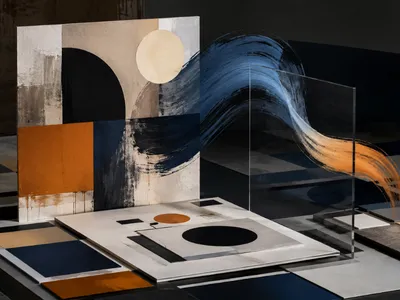
The concept of balance extends this unity through the careful distribution of visual weight. Symmetrical arrangements project stability and formality, while asymmetrical compositions generate dynamic tension by counterbalancing disparate elements—a small, vividly colored shape can anchor an expanse of neutral field just as effectively as a large, muted form.
Achieving equilibrium requires a nuanced understanding of how value, saturation, and edge contrast affect perceived mass. A textured area with high tonal contrast carries more visual weight than a smooth, low-contrast zone, compelling the artist to orchestrate these variables with precision. Mastering this interplay separates competent arrangement from truly resonant composition, where every mark feels both necessary and perfectly placed within the whole.
| Principle | Function in Unity | Function in Balance |
|---|---|---|
| Proximity | Groups related forms to reduce visual clutter | Clusters become singular weighted units |
| Repetition | Creates rhythm and predictable patterns | Establishes symmetrical or asymmetrical anchors |
| Contrast | Defines hierarchy within a unified field | Modulates visual weight through tonal extremes |
These structural pillars function not as rigid formulas but as adaptive strategies. Mastery emerges through iterative refinement, where each decision is tested against the work’s internal logic. The most compelling compositions feel both inevitable and surprising—an outcome only achievable when unity and balance are treated as active, reciprocal forces rather than passive background conditions.
Guiding the Viewer’s Eye Through Composition
Strategic composition guides the viewer’s attention, transforming static imagery into a temporal experience. Movement is orchestrated through directional lines, implied gestures, and graduated transitions that establish a sequence of visual discovery. Linear elements—edges, figure gestures, or implied sightlines—act as visual pathways, connecting focal points, while diagonal axes introduce energy and curved trajectories slow the gaze, encouraging engagement with transitional zones.
Flow captures the qualitative nature of this movement, ranging from abrupt, staccato shifts to smooth, fluid transitions. Artists modulate flow via edge softness, value gradation, and texture density, creating passages that accelerate the gaze or invite lingering attention. Thoughtful placement of entry points, resting areas, and exit paths establishes a coherent visual narrative, ensuring the composition feels intentional and guiding perception naturally.
Strategic Emptiness: Negative Space
Negative space acts as an active structural element rather than simple absence. Its careful use shapes perceptual closure, inviting the viewer to complete forms and engage with the work’s meaning. Expansive voids surrounding positive forms create tension, establishing a hierarchy where empty zones are as architecturally significant as the rendered elements.
Artists manipulate negative space to control rhythm and pacing. Dense clusters of forms generate visual weight, while open passages provide breathing room, preventing fatigue and guiding the eye. The figure-ground relationship is often reversible, with unpainted areas conveying memory, absence, or potential, resonating with viewers attuned to minimalism’s legacy.
Precise deployment of emptiness requires deliberate decision-making. A single misplaced void can disrupt coherence, whereas well-calibrated intervals transform isolation into intention. This precision distinguishes intuitive cropping from calculated spatial orchestration. Emptiness becomes presence when treated intentionally, allowing the void to direct, frame, and animate the viewer’s interpretive journey.
Before constructing a composition, consider these functions of negative space as identified in compositional theory:
- Framing Isolates subject
- Breathing Prevents overload
- Emphasis Directs attention
- Ambiguity Invites interpretation
How Do Color and Texture Shape Emotion?
Color functions as both a physiological and psychological trigger, eliciting immediate emotional responses before intellectual processing occurs. Its perceptual impact—shaped by hue, saturation, and value—establishes the emotional tone of any composition, guiding viewer perception instinctively.
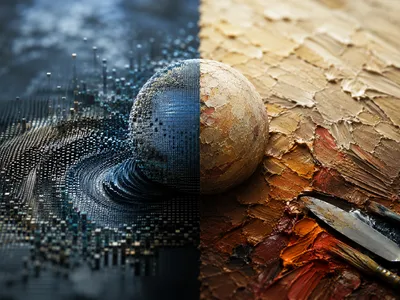
Artists use color relationships to convey mood and symbolism. Complementary palettes create tension and vibrancy, while analogous schemes foster harmony. Combined with temperature shifts and texture—simulated surface qualities like roughness or reflectivity—these choices enhance depth, evoke tactile memory, and intensify emotional nuance in visual storytelling.
The following table outlines how color and texture interact to produce distinct psychological effects in contemporary painting:
| Color Strategy | Texture Application | Psychological Effect |
|---|---|---|
| High-chroma primaries | Smooth, unmodulated surfaces | Directness, childlike clarity |
| Muted earth tones | Heavy impasto, visible strokes | Groundedness, physical presence |
| Analogous cool hues | Soft blending, glazing | Contemplation, spatial depth |
The synergy between color and texture generates works that function on multiple sensory levels. When these elements are orchestrated with precision, they transcend decoration, becoming conduits for emotional specificity. The artist who masters this toolkit wields the capacity to shape not only what is seen but how it is felt.