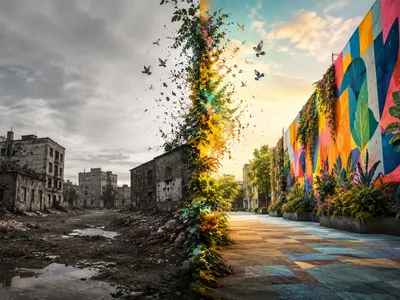
How Does Public Art Influence Neighborhood Value?
The presence of curated public art often signals a neighborhood’s commitment to cultural vitality, a signal that real estate markets translate into higher transaction prices. This capitalization effect, known as the aesthetic premium, reflects how artistic installations function as durable amenities that enhance both visual appeal and perceived social status.
Quantifying this premium requires disentangling art’s contribution from other locational advantages. Hedonic pricing models consistently reveal that properties within close proximity to significant public artworks command a premium, though the magnitude varies substantially based on the artwork’s prominence, maintenance, and integration with surrounding architecture.
Scholars have further refined this analysis by distinguishing between “iconic” landmark installations and smaller-scale community murals. While iconic works generate a measurable, often substantial, uplift, the effect of smaller interventions is more context-dependent, frequently emerging only when embedded within broader placemaking strategies that include pedestrian infrastructure and mixed-use zoning.
Before examining the specific mechanisms that drive this valuation, it is useful to consider the primary channels through which public art exerts its influence. The following factors consistently appear in empirical studies as mediators of the art–value relationship.
- Enhanced visual amenity and reduction of blight perception
- Increased foot traffic supporting local retail vitality
- Cultural signaling that attracts higher-income demographics
- Durable public investment anchoring private reinvestment
Researchers have also noted that the premium is not uniform; it exhibits a nonlinear relationship with distance, typically peaking within a 200‑meter radius and dissipating beyond 500 meters. Such spatial decay patterns underscore the importance of precise geographic data in valuation studies.
Unpacking the Causal Mechanisms
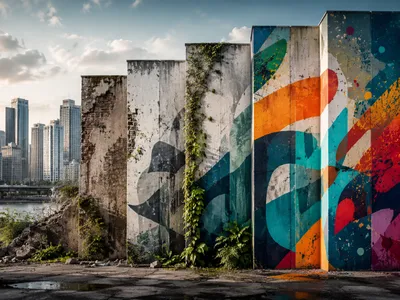
Linking public art to property values requires identifying mediating mechanisms beyond correlation. Key pathways include place identity formation, where art transforms urban spaces into recognizable destinations, influencing buyer behavior and willingness to pay for authenticity through urban murals as public art statements, and risk signaling, where installations signal municipal commitment to infrastructure and safety, reducing perceived investment uncertainty.
A subtler effect arises from the aggregation of social capital. Art serves as communal gathering points, fostering informal interaction and civic engagement. Neighborhoods with sustained public art programming demonstrate higher community participation, which aligns with stable and appreciating property values over time.
- ⭐ Place identity – transforms spatial cognition and neighborhood distinctiveness
- ⭐ Risk signaling – acts as a credible indicator of public and private commitment
- ⭐ Social capital – fosters networks that underpin collective efficacy
- ⭐ Economic multipliers – stimulates adjacent retail and service investment
Empirical work employing quasi‑experimental designs, such as difference‑in‑differences analyses around art installation events, has strengthened confidence in these causal interpretations. A recurring finding is that the premium is most pronounced in neighborhoods undergoing transition, where art functions as a catalyst for reinvestment rather than a mere amenity.
Location, Context, and Confounding Factors
The capitalization of public art into property values is never a straightforward transaction. Geographic context, existing land-use patterns, and the socioeconomic fabric of a neighborhood all interact with artistic interventions to produce outcomes that defy simple generalizations.
What constitutes a positive amenity in one district may generate negligible effects—or even perceived drawbacks—in another. Researchers have identified several contextual variables that systematically moderate the art-value relationship, ranging from local crime rates to the density of complementary commercial uses.
A central challenge in this literature involves disentangling the effect of art from concurrent urban transformations. Large-scale public art installations rarely occur in isolation; they frequently coincide with infrastructure upgrades, zoning changes, or waves of private development. Without careful identification strategies, empirical estimates risk attributing value increases to art that actually stem from these correlated investments.
The table below synthesizes findings from recent quasi‑experimental studies, illustrating how the estimated premium varies across different contextual conditions. Each study employed either difference‑in‑differences or spatial discontinuity designs to isolate the causal contribution of the art installation.
| Contextual Factor | Observed Effect on Premium |
|---|---|
| High existing foot traffic (commercial corridors) | Premium amplified (5‑12% within 200m) |
| Low‑income, historically disinvested areas | Premium emerges only with complementary public safety investments |
| Dense single‑family residential zones | Modest premium (2‑4%), often contested by residents |
| Proximity to existing cultural anchors (museums, theaters) | Cumulative effect; synergy rather than substitution |
| High crime or physical blight adjacent | Premium suppressed or negative until remediation occurs |
These contextual contingencies underscore the importance of moving beyond a one‑size‑fits‑all valuation framework. A mural in a rapidly gentrifying corridor may signal impending displacement, generating ambivalence among long‑term residents that market prices do not fully capture.
Scholars increasingly adopt spatially heterogeneous treatment effect models to account for such nuance. Findings consistently show that art contributes most to property values when it aligns with mural art trends redefining city landscapes, specifically when it is integrated with active ground‑floor uses and maintained through clear stewardship arrangements. Isolated art objects in poorly maintained surroundings rarely produce sustained premiums.
Can Public Art Strengthen Community Resilience?
Evaluating public art solely through transactional property values neglects its broader civic contributions. Investments often target social cohesion, cultural representation, and resilience, fostering long-term neighborhood trajectories that eventually influence property markets. Participatory art projects enhance collective efficacy and reduce residential turnover, stabilizing communities beyond immediate financial metrics.
Quantitative methods like contingent valuation and discrete choice experiments show residents value authenticity and engagement, not just aesthetics. Policy approaches that treat art as a mere property-value lever risk exclusion, whereas frameworks emphasizing preserving cultural identity alongside economic benefits ensure sustainable gains for existing communities.