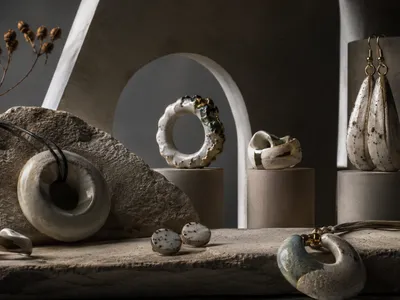
Clay, Fire, and Vision
The alchemy of transforming a handful of earth into a durable object has captivated human creativity for millennia. This ancient practice, however, extends far beyond mere craft, serving as a profound medium for artistic expression where the artist's vision is indelibly marked by the inherent properties of the material itself. The plasticity of clay offers a unique immediacy, recording the slightest pressure of the artist's fingers.
Fire, the second critical agent in this process, acts as the ultimate collaborator, permanently fixing form while introducing elements of chance and uncontrollable beauty. The intense heat of the kiln instigates a chemical metamorphosis, vitrifying the silica and creating a new, stone-like substance. This transformation is where technical knowledge meets artistic intuition, as the ceramist must anticipate the effects of atmosphere and temperature on their work.
The most compelling ceramic art emerges from a deep, almost dialogical, relationship with these fundamental elements. The artist does not merely impose a pre-conceived form onto inert matter but rather engages in a responsive process, listening to the material's own tendencies and respecting the volatile nature of the kiln. This dialogue between maker, material, and fire is what elevates a piece from a simple vessel to a powerful statement of aesthetic intent, encapsulating a moment of creative tension between control and surrender. The resulting object embodies not just a form, but the entire energetic history of its creation, a concept central to understanding the work of master potters. Vision is rendered tangible through this elemental collaboration.
Pioneers of Modern Ceramics
The early 20th century witnessed a seismic shift in the perception of ceramics, moving it from the realm of anonymous craftsmanship into the forefront of modern artistic discourse. Central to this transformation was the figure of Bernard Leach, whose philosophy, articulated in his seminal work "A Potter's Book," advocated for a synthesis of Eastern and Western aesthetic principles. He championed the idea of the artist-potter, deeply involved in every stage of production from digging the clay to firing the kiln.
Leach's collaborative journey with the Japanese potter Shoji Hamada proved foundational, introducing the concept of the mingei (folk craft) movement to a Western audience. Hamada's work exemplified a seemingly effortless spontaneity, where the beauty of a piece resided in its irregularity, the texture of its glaze, and the visible traces of the making process. This stood in stark contrast to the industrial perfection that dominated the era, offering instead a vision of art integrated with daily life. Their partnership redefined the studio pottery movement.
Concurrently, in Vienna and later London, Lucie Rie was forging a distinctly different, yet equally influential, modernist path. Her work, characterized by its precise forms, refined surfaces, and innovative use of color, brought a sophisticated, architectural sensibility to the potter's wheel. Rie's approach was less about rustic tradition and more about a sleek, contemporary elegance, exploring the interplay of line, volume, and texture with a quiet but radical modernism.
These pioneering figures collectively dismantled the hierarchical boundaries between fine art and craft. By demonstrating that clay could be a vehicle for profound personal expression and conceptual depth, they laid the groundwork for subsequent generations. Their studios became laboratories for artistic inquiry, where questions of form, function, and surface were explored with unprecedented rigor and intentionality.
The legacy of these early masters is not merely a collection of beautiful objects but a transformed conceptual landscape for the medium itself. They established the core tenets of the studio pottery movement: a reverence for material, a mastery of process, and an unwavering commitment to the artist's individual vision. Through their dedication, they elevated the potter from a skilled artisan to a recognized artist, proving that the most humble materials could give rise to works of enduring power and significance. This foundational period essentially created the context within which all subsequent ceramic art would be understood and evaluated.
How Do Artists Master Their Materials?
Achieving mastery in ceramics requires far more than technical proficiency on the potter's wheel; it demands a deep, almost intuitive understanding of the material's complex physical and chemical behavior. The artist must become a scientist of sorts, learning to predict how different clays will respond to forming techniques, drying, and the extreme heat of the kiln. This knowledge forms the bedrock upon which artistic expression is built, transforming raw potential into controlled reality.
The selection of a specific clay body, whether the brilliant white of porcelain or the gritty, dark tones of stoneware, is a fundamental aesthetic decision. Each type possesses unique properties of plasticity, porosity, and thermal expansion that dictate its structural possibilities and response to gglazes. Porcelain, for instance, demands immense skill due to its fineness and tendency to warp, yet its translucency offers unparalleled beauty. The glaze chemistry presents another layer of complexity, where metallic oxides and other compounds interact in the kiln to produce a staggering array of colors and textures, often with unpredictable results.
To illustrate the critical role of kiln atmosphere, consider the different effects achieved through various firing techniques:
| Firing Technique | Atmosphere | Characteristic Surface Effect |
|---|---|---|
| Oxidation Firing | Oxygen-rich | Produces bright, stable colors in glazes; predictable results. |
| Reduction Firing | Oxygen-starved | Alters color of metallic oxides (e.g., copper turns red), creates variegated, earthy effects. |
| Raku Firing | Post-firing reduction | Rapid cooling and smoking create unpredictable crackled glazes and dramatic blackened areas. |
| Soda Firing | Vapor glazing | Introduced soda ash vaporizes and coats the work, creating a thin, textured, orange-peel-like glaze. |
Mastery, therefore, is not about eliminating these variables but about learning to collaborate with them. The most accomplished artists understand that the kiln is an active participant, introducing elements of chance that can lead to breathtaking discoveries. This sophisticated engagement with process, where technical control meets an openness to serendipity, is the hallmark of true expertise. It allows the artist to push beyond mere repetition, using their deep material knowledge as a springboard for continuous innovation and the creation of work that is both technically astounding and deeply expressive. The path to mastery is a lifelong dialogue with the elemental forces of clay, fire, and chemistry.
Global Traditions in Ceramic Art
Ceramic art does not exist within a cultural vacuum; it is a global language shaped by millennia of regional innovation, trade, and cross-cultural exchange. The distinctive traditions that emerged across continents continue to inform contemporary practice, offering a rich lexicon of forms, techniques, and philosophical approaches. Understanding these global lineages is essential for appreciating the depth and diversity of the medium today.
The ceramic traditions of East Asia, particularly those of China, Korea, and Japan, have exerted an enduring influence on the global ceramic consciousness. Chinese porcelain, with its pristine whiteness and translucency, became a coveted commodity along the Silk Road, inspiring emulation from the Islamic world to Europe. The Japanese aesthetic, valuing irregularity and the beauty of natural ash glazes, offered a powerful counterpoint to Western ideals of perfection. These Eastern philosophies emphasized harmony with natural processes. Meanwhile, the Islamic world perfected lusterware, a technique producing metallic reflections, while European factories like Meissen cracked the code of hard-paste porcelain, initiating a tradition of ornate sculpture and fine dinnerware.
| Tradition | Geographic Sphere | Key Characteristics | Enduring Legacy |
|---|---|---|---|
| Chinese Porcelain | East Asia | Hard-paste, translucent, blue-and-white decoration, celadon glazes | Established standard for fine ceramics; influenced global production |
| Japanese Mingei | Japan | Folk craft, rustic forms, natural glazes, emphasis on utility and anonymity | Shaped studio pottery philosophy (Leach, Hamada) |
| Islamic Lusterware | Middle East | Metallic sheen, complex geometric patterns, tin-opacified glazes | Advanced ceramic chemistry; influenced Spanish and Italian maiolica |
| European Maiolica | Italy/Renaissance Europe | Tin-glazed earthenware, brightly painted narrative scenes | Elevated pottery to painted canvas; precursor to delftware |
These traditions were not static; they evolved through dynamic interaction, as trade routes carried not only goods but also techniques and aesthetic sensibilities across borders. The contemporary artist navigates this global heritage with a new consciousness, selectively drawing upon historical methods while infusing them with personal and political meaning. For instance, an artist might employ the precise forms of Song dynasty ceramics to address themes of cultural displacement, or adapt the communal firing practices of an African village to explore collective memory. This synthesis of the global and the prsonal ensures that ancient traditions remain vital, continuously reinvented through the lens of individual experience. The following techniques, drawn from various global traditions, remain foundational in contemporary studios:
-
RakuOriginating in 16th-century Japan, this low-fire process emphasizes immediacy and the unpredictable effects of post-firing reduction.
-
Terra SigillataAn ancient technique using refined clay slips to create a smooth, semi-lustrous surface, perfected by Greek and Roman potters.
-
MaiolicaA tin-glazing method from the Italian Renaissance that provides an opaque white ground for detailed painted decoration.
-
NerikomiA contemporary Japanese technique involving the careful construction of patterned colored clay blocks, which are then sliced to reveal the design.
Defining a Master Potter
The designation of "master potter" extends far beyond technical competence or years of experience; it signifies an individual whose work embodies a profound synthesis of skill, innovation, and conceptual depth. Such artists do not simply replicate established forms but engage in a continuous process of inquiry, pushing the boundaries of what is possible with clay while remaining deeply rooted in its material realities. Their mastery is recognized not merely in the objects they produce but in their contribution to the ongoing dialogue of the field.
A master potter demonstrates an intimate knowledge of materials, understanding the subtle behaviors of various clays and glazes with an almost intuitive precision. This is coupled with uncompromising technical skill, whether in throwing, hand-building, or firing, allowing for the flawless execution of complex ideas. However, technique serves a higher purpose: the articulation of a distinct artistic vision. The master’s work is instantly recognizable, characterized by a cohesive aesthetic that might explore themes of impermanence, the relationship between interior and exterior space, or the tension between the organic and the geometric. Furthermore, they exhibit a capacity for continuous reinvention, avoiding stagnation by constantly challenging their own assumptions and exploring new formal territories. Ultimately, the master potter contributes to the evolution of the medium itself, expanding its expressive potential and inspiring future generations to see clay not as a craft material, but as a profound medium for artistic exploration and human expression. Their legacy is measured in influence, in the new paths they forge for others to follow.