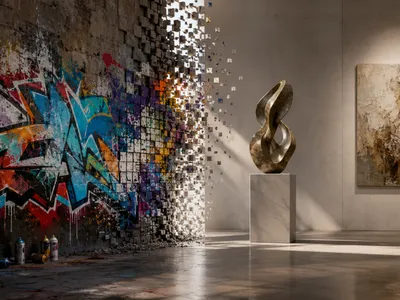
The Political Awakening of Walls
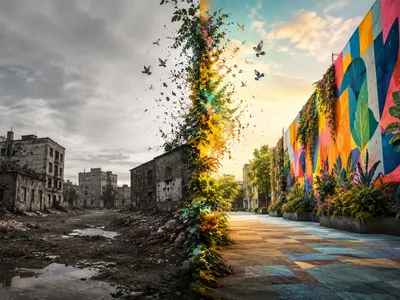
Contemporary muralism has decisively shifted from decorative aesthetics to a potent medium for socio-political discourse, fundamentally challenging traditional perceptions of public space. This transformation positions the city wall not as a passive surface but as an active participant in democratic dialogue and dissent.
Artists now engage in complex critiques of systemic power, tackling issues from climate justice to immigration policies with unprecedented directness.
This trend signifies a move towards what scholars term spatial justice, where marginalized voices reclaim narratve authority within the visual ecology of the city. The mural becomes a lasting testament to public sentiment, often outlasting the transient nature of digital protest.
Augmented Reality Murals
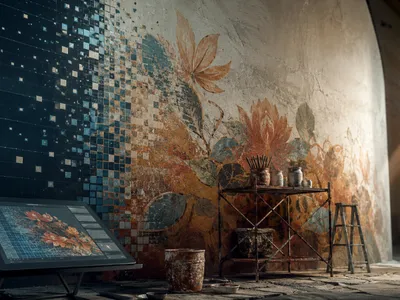
The integration of Augmented Reality (AR) technology with physical street art represents a paradigm shift, creating layered, dynamic experiences that transcend static imagery. This fusion generates a hybrid urban canvas accessible only through smartphone interfaces.
AR murals establish a dialectical relationship between the permanent paint layer and ephemeral digital content, enabling narratives to evolve, animate, or respond to real-time data.
| AR Layer Function | Impact on Urban Experience |
|---|---|
| Narrative Extension | Unfolds storylines, reveals hidden characters or backstories invisible to the naked eye. |
| Real-Time Interaction | Allows viewers to influence animation, soundscapes, or data visualizations via their device. |
| Contextual Information | Overlays historical data, artist statements, or activist calls-to-action onto the physical work. |
This technological intervention democratizes artistic augmentation, allowing for clandestine or temporary digital statements in regulated spaces, thus complicating notions of vandalism and authorized art. The physical mural acts as a permanent anchor for a perpetually updatable digital discourse.
Consequently, the cityscape becomes a browsable, interactive archive, challenging passive viewership and fostering a more engaged, technologically-mediated relationship with public art.
How Does Anamorphic Art Transform Architecture?
Advanced techniques in perspective and anamorphosis are redefining mural art's interaction with architectural form, creating immersive, site-specific experiences that challenge perceptual norms. This sophisticated approach manipulates spatial cognition.
Artists employ complex mathematical calculations and meticulous projection techniques to create images that cohere only from a singular, predetermined vantage point.
This practice transforms flat, dormant facades into dynamic, interactive portals, suggesting cavernous depths, dramatic extensions, or impossible structural interventions that exist solely within the viewer's perceptual field. The anamorphic mural does not passively adorn a wall but actively converses with its geometry, making the building's own form a critical component of the artwork's meaning and impact.
Beyond spectacle, this trend engages with phenomenological philosophy, emphasizing that reality is constructed through embodied perception. The artwork's complete form remains ungraspable from most angles, privileging the journey and specific encounter over a static, omnipresent image. This creates a uniquely personal and temporal experience of public art, where discovery and viewpoint become central to the work's narrative and effect.
How Can Murals Protect Urban Cultural Heritage?
The role of mural art in urban developmnt dynamics has evolved into a complex, self-aware practice that critically engages with its own socioeconomic implications.
| Historical Phase | Primary Function | Community Impact |
|---|---|---|
| Early Revitalization | Aesthetic improvement and 'artwashing' to increase property values. | Often precursor to displacement and cultural erasure. |
| Critical Response | Artistic commentary on gentrification, using murals to protest displacement. | Raises awareness but may not halt economic forces. |
| Proactive Safeguard | Legal integration into cultural heritage plans and community land trusts. | Anchors cultural identity and asserts right to the city. |
Increasingly, communities and artists are leveraging murals as formal instruments of cultural preservation, embedding them within legal frameworks like heritage designation or community benefit agreements. This strategic shift seeks to convert symbolic capital into tangible protections against erasure.
By documenting indigenous histories, minority narratives, and local iconography in large-scale, permanent formats, these works become non-negotiable landmarks of identity. This institutionalization of street art, while controversial, represents a pragmatic turn towards using aesthetic production as a shield, ensuring that development must contend with and incorporate the community's self-representation, thereby fundamentally altering the power dynamics of urban change.