From Graffiti to Gallery

The historical evolution of urban murals demonstrates a significant paradigm shift in aesthetic perception within public spaces. Once relegated to the realm of illicit graffiti, often viewed through a lens of social deviance and property defacement, these visual forms have undergone a profound institutional and cultural re-evaluation. Scholars such as Lachmann (1988) traced the transition from territorial 'tagging' to complex pictorial pieces, marking an internal maturation within street art's own hierarchies.

This journey from vandalism to validated art is inextricably linked to the movement's co-option by the formal art world. Galleries began showcasing artists like Banksy and Jean-Michel Basquiat, while municipal public art programs started commissioning large-scale wall works. The critical discourse surrounding street art subsequently expanded, incorporating frameworks from cultural studies, urban geography, and postmodern aesthetics, thereby legitimizing its academic and artistic scrutiny.

This transformation is not merely chronological but conceptual, challenging entrenched dichotomies between high and low culture. It forced a redefinition of the "artist," the "gallery," and the "art market," as murals exist in a liminal space between ephemeral street culture and commodifiable asset. The tension between unsanctioned expression and sanctioned muralism remains a central dialectic, fueling the genre's dynamism and critical edge, while simultaneously anchoring it within broader socio-economic art circuits.

Era Primary Characteristic Key Theorist/Artist Reference
1970s-1980s Subcultural, territorial marking, NYC subway art Fab 5 Freddy, Martha Cooper
1990s-2000s Global diffusion, stencil art rise, initial gallery interest Banksy, Shepard Fairey
2010s-Present Festivalization, municipal commissioning, digital documentation JR, Blu, Urban Art biennales

A pivotal catalyst was the proliferation of international mural festivals, which function as curated platforms for artistic production. Events like Mural Arts Philadelphia or Nuart Festival in Norway professionalize the practice, providing artists with materials, permissions, and stipends. This institutional framework fosters stylistic innovation on an architectural scale, yet scholars debate whether it sanitizes the art's inherently rebellious spirit, transforming grassroots expression into a tool for urban boosterism and tourism.

The trajectory from graffiti to gallery underscores a complex negotiation between autonomy and assimilation. The mural's power as a public statement often stems from its ability to retain a trace of its outsider origins, even when displayed within the white cube of a museum or funded by civic authorities, thus continuously interrogating the very boundaries of artistic legitimacy.

The Canvas of the City

Urban murals fundamentally reconfigure the phenomenological experience of the built environment. They transform passive architectural surfaces—blank walls, gable ends, concrete barriers—into active sites of visual communication and aesthetic encounter. This process, termed by some as "place-making," injects narrative and identity into otherwise anonymizing urban landscapes, fostering a unique sense of localized character.

The city itself becomes a dialogic canvas, where the artwork engages in a constant converstion with its surroundings. A mural's meaning is contingent upon its context: a socio-political piece in a gentrifying neighborhood reads differently than the same image in a financial district. This site-specificity is a core tenet, distinguishing it from portable gallery art and anchoring its critical function within urban discourse.

  • Architectural Integration: Murals often employ trompe-l'oeil techniques that interact with windows, pipes, and structural elements, creating a playful or critical illusion that challenges perceptions of reality and architecture.
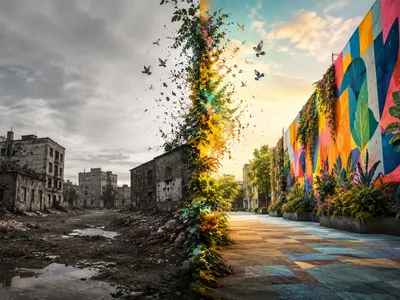
  • Neglected Space Reclamation: Derelict lots, abandoned buildings, and decaying industrial zones are frequently targeted, thereby symbolically and aesthetically revitalizing areas overlooked by formal urban planning.
  • Scale and Monumentality: The immense size of many murals creates an overwhelming, awe-inspiring presence that dominates the visual field, a quality unattainable in traditional framed art, demanding public attention.

This transformation of the urban canvas is not apolitical. The selection of which walls are painted—and by whom—involves gatekeeping by property owners, municipal agencies, and festival curators. Thus, the "canvas" is always a contested terrain, reflecting power dynamics over who has the right to the city's visual voice. The resulting landscape is a palimpsest of sanctioned and unsanctioned works, each vying for visibility and interpretive authority within the shared public realm.

Urban Surface Type Artistic Potential & Challenge Common Thematic Approaches
Historical Building Facade Dialogue with heritage; strict preservation regulations. Historical homage, stylistic contrast, augmented reality.
Modernist Blank Wall Large, uniform area; potentially sterile canvas. Geometric abstraction, large-scale portraiture, social commentary.
Infrastructure (Bridge, Silo) Unique shapes and curvatures; high visibility. Form-fitting designs, optical illusions, celebration of industry.

The Sociopolitical Voice in Paint

Urban murals serve as a potent medium for sociopolitical discourse, transforming public walls into platforms for dissent, memory, and advocacy. This function positions them as a form of visual rhetoric, where aesthetic choices are deliberately deployed to persuade, mobilize, or critique hegemonic power structures. The very act of claiming public space for a counter-narrative is, in itself, a political statement about the right to the city.

The thematic content of such murals often addresses systemic injustices, including racial inequality, gender violence, ecological crisis, and migrant rights. For instance, the iconic "Black Lives Matter" murals painted on city streets globally function as both memorial and protest, spatially anchoring social movements. These works create a durable, highly visible archive of public sentiment that challenges official histories and mainstream media narratives, fostering collective identity among marginalized communities.

Political Function Artistic Strategy Exemplary Case
Memorialization & Mourning Hyper-realistic portraiture, symbolic use of flowers/candles Mural for George Floyd in Minneapolis, USA
Resistance & Solidarity Monumental figures, collective portraits, raised fists "We Are the Granddaughters of the Witches You Couldn't Burn" (Global feminist murals)
Critique of Power Satire, caricature, juxtaposition of symbols Murals critiquing police brutality or corporate greed in Latin America

The efficacy of this voice hinges on its public accessibility and capacity to bypass traditional media gatekeepers. A mural's message is encountered involuntarily in daily life, creating an unavoidable visual confrontation with issues that might otherwise be ignored. This disruptive quality is central to its power, although it also makes such works targets for censorship, defacement, or official removal, as seen in regimes that tightly control public imagery.

The sociopolitical mural exists in a complex relationship with its audience and patrons. When commissioned by grassroots organizations, its activist integrity is clear. However, when similar imagery is co-opted by governmental bodies or corporations, it risks becoming a form of art-washing—using art to soften or distract from underlying conflicts. This tension necessitates a critical analysis of not only the image itself but also the political economy of its production and the intentions behind its display.


Navigating the Space Between Vandalism and Validation

The legal and cultural status of urban murals is perpetually contested, oscillating between the criminalized act of vandalism and the celebrated pursuit of public art. This liminality is not a flaw but a constitutive element of the form's critical potential. The initial illegality of graffiti bestowed upon it an aura of authenticity and rebellion, which becomes diluted through processes of institutional validation and commercialization.

Municipal governments often grapple with this duality, implementing formalized mural programs as a strategy to manage urban aesthetics and reduce illegal graffiti. These programs, while providing legal channels and resources for artists, establish bureaucratic frameworks involving permits, content guidelines, and property owner consent. This regulatory apparatus, though well-intentioned, can neuter the spontaneous, critical edge of street art, transforming it into a sanctioned tool for civic beautification and social control.

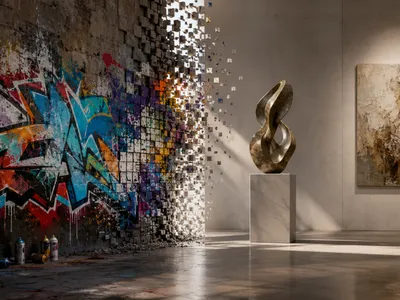
The art market further complicates this navigation. The practice of "de-muraling"—physically removing a wall section to sell it at auction—epitomizes the commodification of a fundamentally site-specific and public artwork. This act severs the work from its context, its communityy, and its original intent, repackaging it as a private luxury good. Consequently, artists themselves must navigate this treacherous terrain, balancing the desire for recognition and income against the potential co-option and neutralization of their work's meaning.

Status Category Defining Characteristics Typical Legal/Institutional Response
Illegal Graffiti/Vandalism Unsolicited, often text-based (tags), perceived as defacement. Fines, removal/abatement programs, criminal prosecution.
Unauthorized Street Art Unsolicited but image-based, often with social content. Ambivalent; sometimes removed, sometimes preserved as cultural asset.
Commissioned Public Art Mural Formally approved, funded, often through a curated process. Celebrated, protected, marketed as part of city identity.

This navigation directly impacts artistic autonomy. The threat of legal repercussion can stifle truly subversive content, while the lure of commissions and festival invitations can incentivize self-censorship or stylistic repetition. The most resonant murals often emerge from artists who skillfully operate within this ambiguous space, leveraging the symbolic capital of illegality while accessing institutional support to achieve scale and permanence, thus maintaining a critical dialogue with both the street and the establishment.

Ultimately, the space between vandalism and validation is a discursive battlefield where definitions of art, property, and public space are constantly negotiated. The mutable status of any given mural—today's vandalism becoming tomorrow's cherished landmark—reveals the fluid and socially constructed nature of these categories, challenging static notions of aesthetic value and legal ownership in the urban realm.

Ephemeral Messages on Permanent Walls

Urban murals embody a profound temporal contradiction: they are ephemeral statements rendered on ostensibly permanent architectural substrates. This inherent tension between the fleeting and the fixed shapes their cultural meaning and material life. Unlike a painting in a climate-controlled museum, a mural is exposed to weather, pollution, urban development, and human interaction, ensuring its eventual decay or erasure.

This physical impermanence is often a deliberate part of the artistic statement. The knowledge that a work will fade or be painted over lends it a poignant urgency, a memento mori quality that challenges capitalist notions of art as a durable commodity. The mural's lifecycle—from creation to deterioration to disappearance or renewal—becomes a metaphor for the transient nature of social movements, public memory, and urban identity itself.

Documentation practices, primarily through digital photography and social media, have emerged as a critical counterforce to this material ephemerality. A mural's "second life" online can grant it global reach and archival permanence far beyond its physical existence. This digital afterlife extends its influence, allowing the message to circulate and resonate long after the paint has peeled, fundamentally altering the traditional relationship between artwork and temporality.

Furthermore, the practice of layering—where new murals are painted over old ones—creates a tangible historical palimpsest on the urban surface. This stratification is not merely destructive; it can be read as a visual record of changing aesthetics, community priorities, and political climates. In neighborhoods undergoing rapid transformation, these layers serve as an unofficial archaeological archive, documenting shifts in power and demographic through competing images and styles.

The planned ephemerality of certain mural projects, such as those using biodegradable paints or created for short-term festivals, highlights a conscious rejection of permanence. This approach aligns with environmental concerns and a critique of monumntal art's authoritarian connotations. By embracing transience, artists and communities can reclaim the right to constantly re-imagine their environment, fostering a dynamic and participatory public sphere that resists static, top-down urban design.

  • Environmental Degradation: Sunlight (UV radiation), acid rain, and temperature fluctuations cause pigment fading and binder failure, leading to a gradual, natural erasure of the image.
  • Anthropogenic Factors: Demolition of the supporting wall, graffiti tag overspray, political censorship leading to whitewashing, or commercial development that obscures or destroys the work.
  • Intentional Transformation: The wall's reuse by other artists (a respectful "going over" or a hostile takeover) or its modification as part of a curated program, symbolizing the continuous dialogue of the street.

The theoretical implications of this ephemerality are significant. It positions the mural not as a finished object, but as an event or a process within the urban fabric. Its meaning is cumulative and contingent, derived from its creation, its period of legibility, and its subsequent alteration or loss. This challenges the art historical fixation on the stable, authentic artwork, proposing instead a model of public art that is iterative, collaborative across time, and deeply integrated into the rhythms of urban change and social life.

Consequently, the value of a mural cannot be assessed solely at its moment of completion. Its full significance unfolds across its entire lifespan, including its degradation and eventual fate. This perspective necessitates new critical frameworks that account for duration, change, and reception over time, urging scholars and curators to consider conservation ethics not merely as preservation, but as the thoughtful management of an artwork's natural and cultural lifecycle within the demanding public realm.