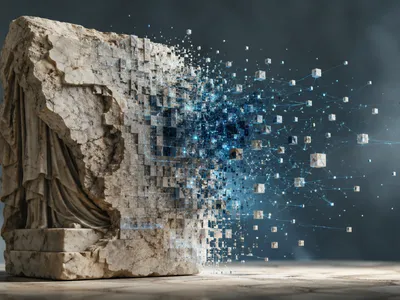
How Does Bio Art Use Living Matter?
Bio art emerges from the convergence of laboratory practices and artistic inquiry, where living tissues, organisms, and biological processes become the primary medium. This field challenges traditional aesthetic categories by positioning life itself as a malleable creative substrate.
Practitioners often collaborate with scientists to cultivate semi-living sculptures or manipulate genetic codes, producing works that interrogate the boundaries between the natural and the artificial. Vital materiality thus replaces conventional pigments, forcing audiences to reconsider agency within art.
A central tension lies in the dual role of the artist as both creator and caretaker of living entities. Such works provoke critical discourse on authorship, as the biological components exhibit autonomous behaviors that resist complete authorial control.
Can Bio Art Protect Biological Data?
Digital ethics in bio art addresses the collection, use, and representation of biological data from human and non-human sources. As artists utilize genomic sequencing, biometric sensors, and AI-driven analysis, the boundary between creative exploration and invasive surveillance becomes increasingly blurred.
Informed consent frameworks from clinical research often fall short in artistic contexts, where participants cannot fully anticipate how their genetic or physiological data will be reused across exhibitions, databases, or derivative works. Additionally, digital archiving of living materials raises questions of ownership and permanence, as replicated data sets leave original donors with limited recourse.
How Does Bio-Digital Art Challenge Agency?
When living tissues and digital data converge within a single artwork, the subject becomes a hybrid entity. This fusion dismantles conventional distinctions between creator, participant, and medium.
Agency flows unpredictably through such assemblages, as biological components exhibit emergent behaviors that algorithmic systems simultaneously track and modify.
Relational autonomy offers a more nuanced framework, acknowledging that consent must be negotiated continuously rather than secured through a one-time signature. The bio-digital artwork thus functions as a dynamic contract, where each exhibition reconfigures the terms of engagement between human contributors, non-human actors, and institutional stewards.
Artists employing living cell lines harvested from donors or utilizing real-time biometric feeds face a paradox: the more intimately the artwork involves its subjects, the more those subjects lose visibility within the final presentation. Post-humanist ethics suggests extending moral consideration to the technological and biological components themselves, yet practical mechanisms for such inclusion remain nascent.
To navigate these complexities, practitioners are developing iterative consent protocols that adapt to the mutable nature of bio-digital works.
-
Tiered consent modelsAllow donors to specify permissions for research, exhibition, and commercial reuse separately.
-
Smart contracts on blockchainAutomate royalty distribution and track the provenance of living materials across galleries.
-
Participatory governance boardsInclude donors, scientists, and artists in ongoing oversight of bio-art repositories.
Reimagining Consent for Living Materials
Conventional consent frameworks presume a stable subject and a bounded interaction, assumptions that dissolve when materials continue to grow, mutate, and circulate after the artwork’s debut.
Dynamic consent platforms enable ongoing communication between donors and artists, allowing individuals to modify their permissions as the artwork evolves. Relational accountability shifts focus from a single transaction to sustained relationships built on transparency and reciprocity.
Such approaches require infrastructural shifts within galleries and biolabs, moving beyond static waivers toward digital interfaces that log every transformation of the living medium. When a bacterial culture is shared between institutions or its genetic code is edited for a new iteration, the original contributor’s agency must remain traceable and actionable. Embedding consent into the material’s metadata offers one pathway, though it demands interoperability across artistic and scientific platforms that seldom communicate.
Forging Symbiotic Creative Practices
A symbiotic approach recognizes that bio-digital art cannot be governed through external ethical oversight alone. Instead, ethical principles must be embedded within the creative methodology itself, transforming constraints into generative parameters.
Symbiotic ethics reframes the artist not as a sovereign author but as a participant within multi-species networks. This orientation demands new forms of literacy, where technical proficiency in both wet-lab protocols and data governance becomes inseparable from critical reflexivity.
Emerging collaborative models offer concrete pathways for integrating ethical considerations into every stage of production. The table below outlines key frameworks that practitioners are adapting from fields such as environmental humanities, open science, and indigenous data sovereignty.
| Framework | Core Principle | Application in Bio Art |
|---|---|---|
| Care Ethics | Responsiveness to vulnerability | Ongoing maintenance protocols for living sculptures |
| Commoning | Collective stewardship of resources | Shared biorepositories with community governance |
| Digital Sovereignty | Control over data and biological derivatives | Blockchain-verified consent histories |
These frameworks share a commitment to procedural transparency, ensuring that ethical decisions are not hidden within institutional bureaucracy but become visible elements of the artwork’s public presence. When audiences encounter a bio-art installation, they also encounter the terms of its material origin, fostering a more informed and participatory form of spectatorship.
Achieving such symbiosis requires structural changes within the institutions that support bio art. Funding bodies increasingly mandate ethical integration plans, while residency programs pair artists with ethicists as co-investigators. The aesthetic itself shifts accordingly: works that conceal their ethical negotiations risk being perceived as incomplete, whereas those that foreground them gain depth and legitimacy. Symbiosis becomes both method and message, redefining what constitutes rigorous practice in the twenty-first century.