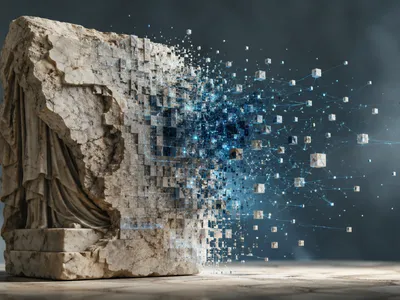
Cultural memory, as a theoretical framework, transcends individual recollection to examine how societies construct and maintain a shared sense of the past through symbolic forms. In the realm of art, it represents the aesthetic and material negotiation of history, identity, and collective experience.
Art functions not merely as a record but as an active agent in this process, shaping what is remembered, how it is felt, and what is strategically forgotten.
The concept distinguishes itself from communicative memory, which spans three generations, by its focus on the institutionalized and durable heritage that anchors a group's longue durée. This memory is crystallized in canonical artworks, monuments, and rituals that provide a stable, though often contested, horizon of meaning. Scholars like Jan and Aleida Assmann have been pivotal in framing this discourse, highlighting art's role in stabilizing cultural identity across temporal chasms. Thus, the artistic "canvas" of memory is both a surface for inscription and a dynamic field of cultural power.
How Artifacts Become Vessels: The Mechanisms of Cultural Encoding
An artwork transforms into a vessel of cultural memory through specific mnemonic mechanisms. These are the processes of selection, condensation, and symbolic charging that elevate an object from an aesthetic artifact to a site of memory (lieu de mémoire).
The first mechanism is material persistence. The physical endurance of a sculpture, painting, or building allows it to bear witness across centuries.
Secondly, semantic density is crucial. The work accrues layers of meaning through historical events, political co-optation, and public reception, becoming a palimpsest of interpretations. For instance, a portrait of a founding figure embodies not just a likeness but the ideals and myths of a nation.
Finally, ritualized engagement—be it through public display, commemorative ceremonies, or educational discourse—activates and renews the memory stored within the artifact. This triadic process ensures that cultural memory is not passively stored but continuously performed and re-negotiated through its artistic vessels.
The following table illustrates the primary mechanisms of encoding across different artistic forms:
| Artistic Form | Primary Mechanism of Encoding | Mnemonic Function |
|---|---|---|
| Monumental Sculpture | Material Persistence & Spatial Dominance | To solidify a singular narrative in public space. |
| History Painting | Semantic & Allegorical Density | To condense complex events into a morally charged, iconic image. |
| Memorial Architecture | Ritualized Engagement (e.g., pilgrimage, ceremony) | To frame collective behavior and emotive experience. |
| Digital Art Archive | Dynamic Re-contextualization & Accessibility | To democratize and destabilize fixed canonical memories. |
This encoding is never neutral; it is inherently political and selective. What an artifact is made to remember simultaneously dictates what it helps society to forget, establishing a continuous dialogue between presence and absence in the cultural imaginary.
Monuments and Counter-Monuments: The Battle for Public Memory
The public square has long been the primary battleground for cultural memory, where the hegemonic narrative is physically imposed through monuments. These structures, often commissioned by state powers, aim to petrify a singular historical truth into the urban fabric, promoting veneration and enforcing social cohesion around a specific ideology.
In response, the late 20th century saw the emergence of the counter-monument (Gegendenkmal). This radical artistic strategy, pioneered by artists like Jochen and Esther Gerz, intentionally subverts traditional memorial forms. Counter-monuments are often ephemeral, interactive, or self-effacing, rejecting didacticism and instead provoking public engagement, doubt, and an active, personal responsibility for remembrance.
This dialectic between monument and counter-monument illustrates the dynamic struggle over public memory. While a traditional equestrian statue commands a fixed gaze, a counter-monument might sink into the ground or require the public's physical participation to become visible, thereby shifting memory from a passive reception of history to an ongoing, demanding practice. The table below contrasts their fundamental approaches:
| Aspect | Traditional Monument | Counter-Monument |
|---|---|---|
| Primary Objective | To stabilize and eternalize an official memory. | To destabilize and question the very process of memorialization. |
| Materiality | Durable, permanent materials (bronze, stone). | Often temporary, fragile, or mutable materials. |
| Viewer Role | Passive spectator of a completed statement. | Active participant necessary for the work's completion/meaning. |
| Temporal Concept | Claims timelessness and finality. | Embraces process, decay, and contingency. |
This artistic battle underscores that cultural memory is not a settled archive but a continuous, polemical performance. The public sphere becomes a forum where art stages the conflicts between remembering and forgetting, authority and subversion. Key examples of this tension include:
- Maya Lin's Vietnam Veterans Memorial: A contemplative, anti-heroic scar in the earth that lists names, requiring personal reflection rather than imposing a collective sentiment.
- Jochen Gerz's "Monument Against Fascism": A lead-covered column in Harburg that was gradually lowered into the ground as citizens signed it, literally withdrawing the monument from view.
- Contemporary Debates on Colonial Statues: The toppling, defacing, or contextualizing of statues acts as a form of unsanctioned counter-monumentalism, demanding a reckoning with oppressive pasts.
The Living Archive: Performance, Ritual, and Embodied Transmission
Beyond static objects, cultural memory finds its most potent and resilient form in performative practices. Here, memory is not stored in an artifact but is enacted through the body, making the living human the primary medium of transmission. This realm encompasses ritual, theater, dance, oral storytelling, and commemorative ceremonies.
These acts create what scholar Diana Taylor terms the repertoire, as opposed to the archive.
While the archive (documents, monuments) holds enduring but often inert materials, the repertoire consists of embodied knowledge—gestures, orality, movement, and live presence—that requires repetition and co-presence to persist. This form of memory is inherently dynamic and adaptive, allowing for subtle transformations with each iteration, which is crucial for the survival of marginalized or non-literate cultural traditions.
Artistic performance, in this context, becomes a vital technology of memory. A ritual dance, a passion play, or a site-specific theatrical performance does not simply represent a past event but re-actualizes it, generating an affective and collective experience in the present. This embodiment resists the erosion of time and the censorship of official histories, as the memory is carried in muscle, breath, and shared emotion. The power of the living archive lies in its vulnerability and its liveness, which demands commuity participation for its very continuation.
The mechanisms of embodied transmission highlight several critical functions of performative memory:
- Somatic Encoding: Knowledge and history are embedded in physical gestures and movements, passed down through demonstration and practice rather than textual instruction.
- Affective Contagion: Live performance generates shared emotional states (mourning, joy, solidarity), forging powerful communal bonds anchored in the remembered past.
- Adaptive Survival: Unlike fixed monuments, performative traditions can adapt their form to new contexts while retaining core narratives, ensuring relevance across generations and in the face of cultural disruption.
Digital Afterlives and the Transformation of Mnemonic Space
The advent of digital technology has precipitated a fundamental paradigm shift in the constitution of cultural memory, creating new virtual topographies for remembrance. Art in the digital realm—encompassing net art, virtual reality, AI-generated works, and vast online archives—operates within a non-linear, network-based mnemonic space that challenges traditional notions of permanence, authorship, and locality.
This environment facilitates a democratization of memory work, enabling the preservation and circulation of previously marginalized or ephemeral histories. However, it simultaneously introduces new forms of fragility and control. The material persistence of the monument is replaced by the contingent durability of data formats, server infrastructure, and corporate policies. Memory becomes subject to algorithmic curation, where search engines and social media feeds act as unconscious editors of the past, prioritizing certain memories while obscuring others in what has been termed "digital oblivion."
Furthermore, digital art can create immersive, interactive mnemonic experiences that collapse temporal distances. A virtual reality reconstruction of a lost historical site, for instance, does not simply represent memory but offers a simulated, embodied encounter with a past space, raising profound questions about authenticity, empathy, and the potential for anachronistic projection. The following table outlines key transformations in mnemonic space brought about by digitality:
| Traditional Mnemonic Space | Digital Mnemonic Space | Implication for Cultural Memory |
|---|---|---|
| Fixed & Site-Specific (e.g., a plaza, museum) | Fluid & Networked (accessible globally, anytime) | De-territorializes memory, separating it from physical community. |
| Authoritative & Curated by institutions. | Participatory & Algorithmically Sorted by platforms and users. | Democratizes but also fragments and privatizes memory narratives. |
| Material Degradation (slow decay of stone, pigment). | Digital Obsolescence (rapid aging of file formats, hardware). | Creates a new form of planned ephemerality and urgent preservation crises. |
| Linear, Historical Narrative | Hypertextual, Database Logic | Disrupts causality, promotes associative and non-linear memory linking. |
Artists like Rafael Lozano-Hemmer or the collective Rimini Protokoll exploit these conditions, creating works where audience data becomes part of an evolving memorial process, or where live feeds blend past and present in real-time. This digitization does not negate cultural memory but radically re-engineers its infrastructure, presenting both unprecedented opportunities for polyvocal remembrance and severe risks of loss, manipulation, and homogenization under the guise of preservation.
Towards an Ethics of Remembering: Responsibility in Artistic Practice
The immense mnemonic power of art necessitates a rigorous ethical framework for its creation and engagement. Moving beyond aesthetic or historical considerations, an ethics of remembering interrogates the moral obligations inherent in representing the past, particularly traumatic or contested histories. It asks not only how we remember through art, but with what right, and to what consequence.
A primary concern is the risk of aestheticization, where the formal beauty or conceptual elegance of an artwork might inadvertently sanitize suffering or render it consumable, thereby betraying the lived reality of the remembered events. Conversely, there is the danger of appropriation, where artists speak for or use the memory of communities to which they do not belong, potentially silencing authentic voices and replicatng colonial power structures. The ethical artist must therefore navigate a path between the necessity of representation and the perils of exploitation, often through strategies of self-reflexivity, collaboration, and the acknowledgment of their own subject position.
Furthermore, an ethical practice considers the affective impact on both descendants of trauma and the wider public. It involves a duty of accuracy that resists simplistic narratives, while also recognizing that memory is inherently partial and subjective. This ethics extends to institutions and audiences, demanding critical literacy about how memory is constructed and a shared responsibility for its future trajectory. Ultimately, ethical remembering in art is not about providing catharsis or closure, but about fostering a responsible, unsettled, and ongoing relationship with the past that can inform more just social relations in the present.
Core principles guiding this ethical approach include:
- The Principle of Non-Fidelity to Horror: Avoids literal, sensationalist, or re-traumatizing representations of violence, opting instead for metaphorical, oblique, or structurally resonant forms that honor the dignity of victims.
- The Principle of Contextualization: Insists that artworks functioning as memory vessels are presented with sufficient historical and critical context to prevent misappropriation or ideological simplification, countering the de-contextualizing tendencies of both the museum white cube and the digital feed.
- The Principle of Mnemonic Justice: Actively seeks to recover, amplify, and give form to the memories of marginalized, subaltern, or silenced groups, redressing the imbalances of the historical archive and challenging dominant national narratives.