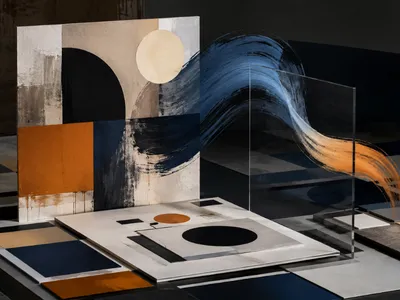
Defining the Hybrid Canvas
Mixed media composition represents a foundational post-modern artistic practice that deliberately incorporates two or more distinct material substances into a single, unified artwork. This methodology transcends traditional disciplinary boundaries, challenging the purity of mediums like oil painting or marble sculpture.
Its core principle is material heterogeneity, where the physical and conceptual properties of each component—be it paper, fabric, wood, or digital elements—contribute to the work's overall semantic depth.
The artistic strategy moves beyond simple collage to engage in a complex dialogue between textures, forms, and historical connotations inherent in each material. Consequently, the surface of a mixed media work becomes a palimpsest of meaning, where layers are both physically and metaphorically visible, inviting a hermeneutic reading that considers the interplay of its constituent parts.
Historical Threads and Avant-Garde Breakthroughs
While the term "mixed media" gained prominence in the 20th century, its conceptual and material precursors are deeply woven into art history. Early modernists, seeking to break from academic traditions, began incorporating non-art materials into their work.
The Cubist experiments of Pablo Picasso and Georges Braque with papier collé (pasted paper) around 1912 marked a pivotal historical juncture, introducing real-world fragments like newspaper and wallpaper into the pictorial plane and irrevocably collapsing the distinction between represntation and objecthood. This radical gesture was expanded by the Dadaists and Surrealists, who utilized found objects and disparate materials to channel the unconscious and critique bourgeois rationality, setting a direct precedent for the post-war assemblage movement and the subsequent explosion of mixed media practices.
| Artistic Movement | Key Contribution | Material Innovation |
|---|---|---|
| Cubism (c. 1912) | Introduction of real-world fragments into the artwork. | Newspaper, wallpaper, fabric (papier collé). |
| Dada | Use of the objet trouvé (found object) for critique. | Everyday manufactured items, readymades. |
| Abstract Expressionism | Emphasis on the materiality and process of the artwork itself. | Sand, glass, string integrated into paint. |
| Neo-Dada & Fluxus | Dematerialization of the art object and emphasis on event. | Ephemeral materials, consumer packaging, audio. |
The Artist's Expanded Toolbox
The contemporary mixed media artist operates with an unprecedentedly vast and eclectic arsenal, where the selection of materials is a primary compositional and conceptual decision. This toolbox is categorically unbounded, embracing both the traditional and the unconventional.
Foundational wet and dry media—such as acrylics, inks, charcoal, and graphite—often serve as a base or connective layer. Onto this, artists integrate two-dimensional substrates like handmade papers, photographs, maps, or vintage textiles, which introduce pre-existing imagery and historical patina. The inclusion of three-dimensional elements marks a critical leap into assemblage, where objects like rusted metal, weathered wood, circuit boards, or organic matter transform the work from a surface into a constructed artifact with tangible depth and shadow.
- Traditional Art Media: Paint, ink, pencil, pastel, watercolor.
- Paper-Based & Flat Materials: Book pages, tickets, stamps, photographs, fabric, wallpaper.
- Textural & Dimensional Elements: Sand, plaster, resin, fibers, beads, wire.
- Found & Manufactured Objects: Keys, gears, bottles, tools, electronic components (objet trouvé).
- Digital & Transient Components: Projected light, sound elements, QR codes, augmented reality layers.
The act of selection is thus a curatorial and symbolic process, where each material's inherent cultural biography and physical properties are harnessed to build complex narratives that pure pigment or stone alone cannot convey.
Core Principles of Multimodal Integration
Successful mixed media composition is governed by several interdependent principles that ensure cohesion amidst diversity. Intentionality of material choice is paramount; every element must justify its presence beyond mere decoration, contributing to the work's thematic core.
A related principle is structural integrity, addressing the physical challenges of adhering disparate substances. Artists must possess or innovate technical knowledge regarding archival adhesives, sealing methods, and load-bearing supports to prevent deterioration or delamination, ensuring the work's longevity.
Furthermore, visual and haptic harmony must be achieved through careful consideration of color, texture, scale, and rhythm. This involves creating a balanced dialogue where no single material dominates unless for specific discursive effect, allowing for a unified aesthetic experience.
The principle of layered meaning is the conceptual engine of the practice. Physical stratification mirrors the accumulation of meaning, where underlying layers remain partially visible, suggesting history, memory, or obscured truths. This palimpsestic quality invites the viewer to engage in active excavation, piecing together the narrative logic of the composition.
Finally, a critical principle is the embrace of contingency and process. Unlike more controlled media, mixed media often involves unpredictable interactions between materials—such as how paint bleeds into paper or how a found object's shape dictates composition. The artist must strategically leverage these emergent properties, integrating chance operations into the creative workflow to generate novel outcomes that rigid planning could not foresee.
Conceptual Depth and Material Meaning
In mixed media, materials are never neutral; they function as semiotic carriers with inherent cultural, historical, and personal biographies. The artist's choice of a vintage ledger page versus a modern digital print is a deliberate semantic decision.
This practice engages deeply with material culture theory, where objects are understood as nodes within a network of social meaning. A fragment of architectural salvage, for instance, evokes themes of memory, decay, and the passage of time within an urban context, adding layers of narrative that pure paint cannot achieve.
The philosophical underpinning here is that meaning is co-created through juxtaposition. The relationship between a delicate, hand-written letter and a coarse, industrial bolt generates a conceptual friction—a dialectic that prompts the viewer to construct a narrative bridging the intimate and the mechanical, the ephemeral and the permanent. This intertextuality between materials transforms the artwork into a site of active interpretation, where the viewer's own experiences and associations complete the circuit of meaning initiated by the artist's combinatorial strategy.
| Material Type | Common Conceptual Associations | Thematic Utility |
|---|---|---|
| Organic/Ephemeral (leaves, feathers, wax) | Transience, nature cycles, fragility, corporeality. | Explorations of mortality, ecology, and temporal flux. |
| Archival/Textual (old books, maps, documents) | Memory, history, knowledge, personal/collective narrative. | Investigations of identity, historiography, and data. |
| Industrial/Manufactured (metal, plastic, circuitry) | Technology, consumerism, alienation, progress/decay. | Critiques of modernity, waste, and human-machine relations. |
| Domestic/Textile (fabric, lace, utensils) | Labor, gender roles, memory, the body, comfort. | Discussions of private vs. public spheres, tradition. |
Digital Frontiers and New Media Synergy
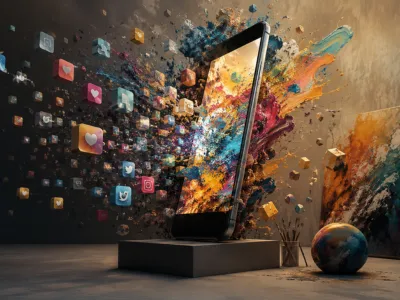
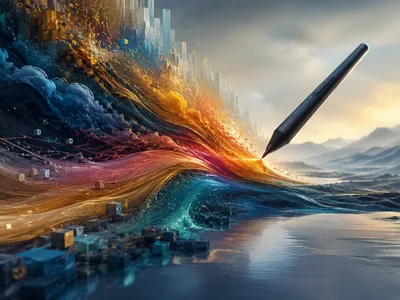
The digital revolution has radically expanded the definition and potential of mixed media, creating a hybrid post-digital aesthetic. This is not merely the use of digital tools to design traditional work, but the genuine integration of computational media as a material in itself.
Artists now seamlessly combine physical assemblages with projected video, generative algorithms, interactive sensors, or augmented reality (AR) overlays. In such works, a painted canvas might serve as a dynamc trigger for a digital animation, blurring the ontological line between the static object and the performative event.
This synergy allows for unprecedented viewer engagement and narrative complexity, where the artwork's state can change in response to external data, audience proximity, or networked input. Furthermore, digital fabrication tools like 3D printing and laser cutting enable the precise production of physical components from virtual models, creating a fluid feedback loop between the digital and the tangible. This convergence challenges traditional notions of authenticity, aura, and the artist's hand, while opening new avenues for exploring themes of virtuality, surveillance, and the nature of presence in a hyper-connected world.
The Enduring Allure of Tactile Fusion
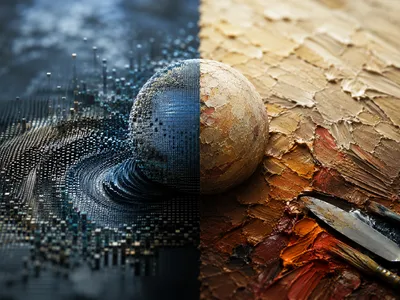
Despite the proliferation of digital and virtual art forms, the tactile materiality of mixed media continues to exert a powerful, irreplaceable allure. This enduring appeal lies in the unique capacity of physical, heterogeneous artworks to engage the viewer on a multisensory level, offering an embodied experience that purely screen-based media cannot replicate.
- Haptic Engagement: The direct, physical invitation to perceive texture, weight, and temperature creates an intimate, phenomenological connection between viewer and object.
- Presence of the Artist's Hand: Visible traces of process—adhesive, brushstrokes, manual assemblage—act as an index of creative labor and authentic human agency.
- Historical and Cultural Palpability: Authentic found objects carry the aura and wear of their history, making time and use tangibly present in a way digital reproductions cannot.
- Unpredictable Materiality: The unique interactions between combined substances often yield surprising, unreproducible formal qualities that celebrate chance and uniqueness.
In an increasingly dematerialized world, the mixed media object stands as a testament to the enduring human need for tangible, complex artifacts that speak not only to the eye but also to the hand and, by extension, to memory and emotion, securing its vital place within the contemporary artistic landscape.