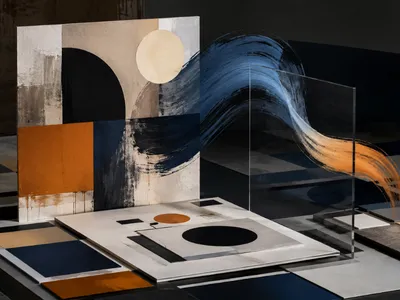
Exploring Materiality Through Mixed Media Art
Mixed media exploration fundamentally redefines the artist's relationship with materiality, transcending traditional categorical boundaries. It is an investigative practice where the inherent properties of disparate substances initiate the creative dialogue. The artist engages not merely as a maker, but as an alchemist, probing the tactile, visual, and conceptual potentials of each element.
This methodology challenges the hierarchy of fine art materials, placing ephemeral or industrial items alongside classical mediums like oil or gouache. The critical decision-making process involves understanding adhesive compatibilities, archival concerns, and the kinetic behavior of combined surfaces over time. Consequently, the studio transforms into a laboratory for material synergy and controlled experimentation, where unexpected reactions between components are often harnessed as central compositional elements.
Historical Evolution of a Radical Practice
The genesis of mixed media as a deliberate avant-garde strategy is traced to early 20th-century modernist movements. Cubist papiers collés by Braque and Picasso introduced non-art materials like newspaper and wallpaper into the picture plane, challenging illusions of depth and authenticity. This radical act dissolved the sanctity of the unified surface. Dadaists, notably Marcel Duchamp and the Hanoverian Kurt Schwitters, escalated this confrontation. Schwitters' Merz constructions utilized urban detritus—tram tickets, wood fragments, wire—to create aesthetic unity from societal rubble, formulating a powerful critique of post-war culture. The mid-century Neo-Dada and Fluxus movements further democratized material choice, emphasizing process, ephemerality, and the breakdown between art and life, thereby solidifying mixed media's philosophical foundation.
How Does Layering Shape Mixed Media Art?
At its core, mixed media exploration is governed by principles of additive layering, material conversation, and intentional hybridity. The practice is not haphazard collage but a structured investigation into how different mediums can coexist to produce a new, coherent visual language.
Methodologically, it often begins with a substrate choice that dictates subsequent layers. Artists employ techniques such as underpainting, embedding, impasto, and transparent glazing to build depth. A critical methodological phaase is the strategic interruption of layers, where sanding, scraping, or tearing reveals historical strata beneath, creating a palimpsest that visually narrates the work's own creation.
The conceptual framework requires a balance between control and contingency. While the artist directs the overall composition, the intrinsic behavior of materials—such as watercolor bleeding into charcoal or wax resisting ink—introduces an element of chance. This dialogue between artist agency and material autonomy is a defining feature of advanced mixed media practice.
The Artist's Evolving Toolbox
The contemporary mixed-media artist operates with an expansive, non-hierarchical arsenal that defies traditional categorization. This toolbox extends far beyond conventional paints and brushes, embracing both analog and digital realms. The strategic selection of materials becomes a critical component of the conceptual framework itself.
Traditional wet and dry media—such as acrylics, oils, inks, charcoal, and pastels—are now routinely combined with sculptural elements like resins, textiles, metals, and found objects. This convergence challenges the historical boundaries between two and three-dimensional expression, demanding artists master diverse technical proficiencies and understand complex material interactions and archival implications.
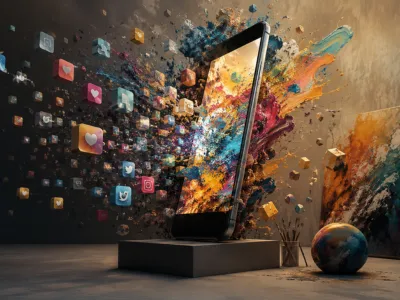
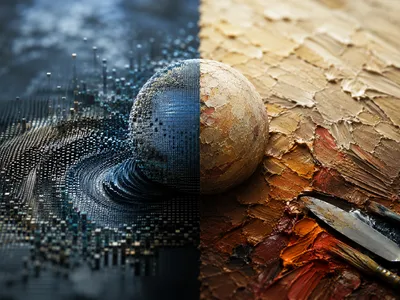
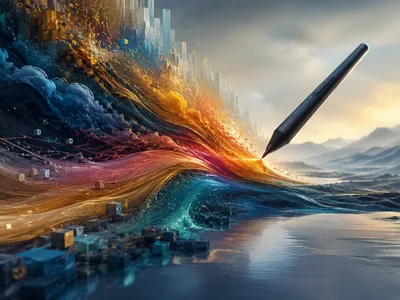
The digital revolution has further radicalized this toolbox. Artists integrate digital printing, laser cutting, and 3D modeling with handcrafted elements, creating hybrid artifacts that question authenticity in the post-digital age. Software becomes a sketchbook, and physical objects are scanned, manipulated, and re-materialized. This technological integration does not replace analog techniques but enters into a dialogue with them, enabling the creation of works that exist simultaneously in virtual and physical spaces, thus expanding the very definition of materiality in art.
Mixed Media Art and Cultural Decentralization
Mixed media practice has played a pivotal role in democratizing artistic production by lowering barriers to entry and validating non-traditional materials.
Its foundational ethos—that meaning can be forged from the mundane and the discarded—empowers creators outside formal institutional training. This accessibility is amplified by digital platforms, where tutorials and communities foster knowledge sharing, further dispersing technical expertise and conceptual frameworks that were once gatekept by art academies.
This democratization extends to subject matter and narrative authority. By incorporating personal ephemera, found photographs, or local materials, artists can articulate highly specific, culturally situated stories that resist universalizing narratives. The medium becoms inherently pluralistic, giving voice to diverse experiences and fostering a more inclusive visual culture. The practice thus functions as a powerful agent of cultural decentralization, challenging the geographic and economic centers of the art world by validating production that occurs in domestic spaces, community centers, and with limited resources.
The legacy of mixed media exploration may lie in its profound redefinition of who can be an artist and what can constitute art. It dismantles the romantic myth of the artist as a sole genius with privileged access to rare materials, replacing it with the figure of the bricoleur, the researcher, and the everyday philosopher who constructs meaning from the world immediately at hand. This shift has irrevocably expanded the scope of contemporary art, making it a more responsive and reflective field.